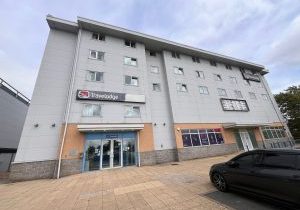
Travelodge Stonehouse | Amicus AquaStore
The technical outcome
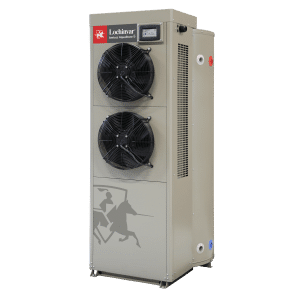
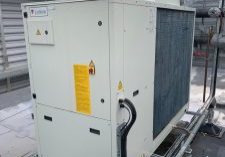
Two Amicus AquaStore LAAS8-455-12 units were selected to meet a calculated 2,000 litre, two-hour peak. Their combined output is 2,112 litres at a 50°C temperature rise. After 1,518 operating hours per unit, recorded immersion use remained limited, indicating that the heat pumps supplied most of the hot water demand. Below is an insight into the survey conducted and the findings recorded on site.
Project at a glance
| Application | Design basis | Selected plant | Operating result |
| 40-bedroom hotel | 2,000 litres over each 120-minute peak | 2 × Amicus AquaStore LAAS8-455-12 | Predominantly heat pump operation |
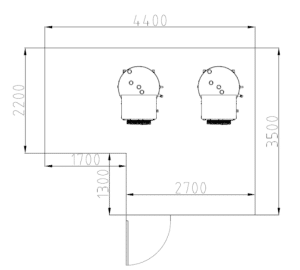
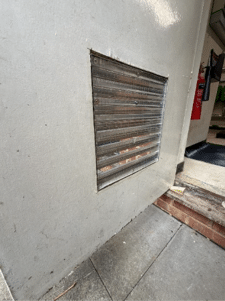
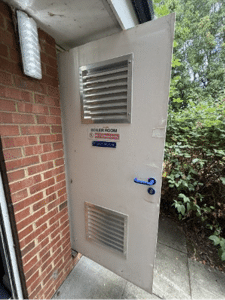
For a hotel, domestic hot water is a guest-critical service. The design must cover concentrated periods of demand, provide sufficient recovery and work within the available plant room conditions. At Travelodge Stonehouse, the engineering review process started with the demand profile and followed it through to model selection, ventilation review and the verification of installed performance.
The challenge: design around the peak
The Stonehouse working example is based on a 40-bedroom hotel. The demand assessment allows 25 litres per person, with two people per room, and assumes two daily peak periods of 120 minutes. This produces a required volume of 2,000 litres during each peak.
| Design input | Value used |
| Hotel size | 40 bedrooms |
| Hot water allowance | 25 litres per person |
| Occupancy basis | 2 people per room |
| Peak profile | 2 peaks per day, each lasting 120 minutes |
| Required hot water per peak | 2,000 litres |
This demand-led approach is important because storage capacity alone does not describe how the system will perform. The design also needs to account for usable draw-off and the volume recovered while demand continues.
Selecting the AquaStore operating strategy
Amicus AquaStore offers three operating modes. The appropriate mode depends on the hot water profile, the required recovery rate and the plant room conditions. Efficiency mode should normally be the starting point. Where peak demand cannot be met consistently in Efficiency mode, Hybrid mode provides additional recovery support without moving fully to electric-only operation.
| Mode | How it operates | Best suited to |
| Efficiency | The heat pump does most of the water heating. In low demand conditions, the upper immersion is not used and the lower immersion operates only if ambient temperature falls below 7°C. | Projects prioritising maximum efficiency where demand can be met mainly by heat pump operation. |
| Hybrid | The heat pump remains the primary heat source, while the immersion elements can support recovery when demand exceeds a predetermined level. | Higher-demand periods requiring faster recovery while retaining heat pump operation as the primary heat source. |
| Electric | The unit operates as a conventional electric water heater using the immersion elements to heat the stored water. | Applications requiring electric-only operation, including winter operation where cold air discharge needs to be avoided. |
Sizing the solution
The selected model was the LAAS8-455-12. Although the nominal storage capacity is 445 litres, the calculation uses 80% of storage for first-hour draw-off. This provides a realistic allowance for usable volume during peak demand and combines that stored volume with ongoing heat pump recovery.
| Sizing point | Single-unit output | Technical interpretation |
| First-hour draw-off at 50°C temperature rise | 706 litres | Usable storage plus heat pump recovery. |
| Second hour at 50°C temperature rise | 350 litres in Hybrid mode | Additional recovery during the extended peak. |
| Two-hour peak production at 50°C temperature rise | 1,056 litres per unit | Two units cover the 2,000 litre design peak. |